TikTok 200-View Jail: Real or Myth? Algorithmic Truths
Stuck at 200 views on every upload? Discover why this view cap happens, how TikTok's test pool algorithm works, and how to break the view ceiling.
VDTik Editorial
Published on June 23, 2026
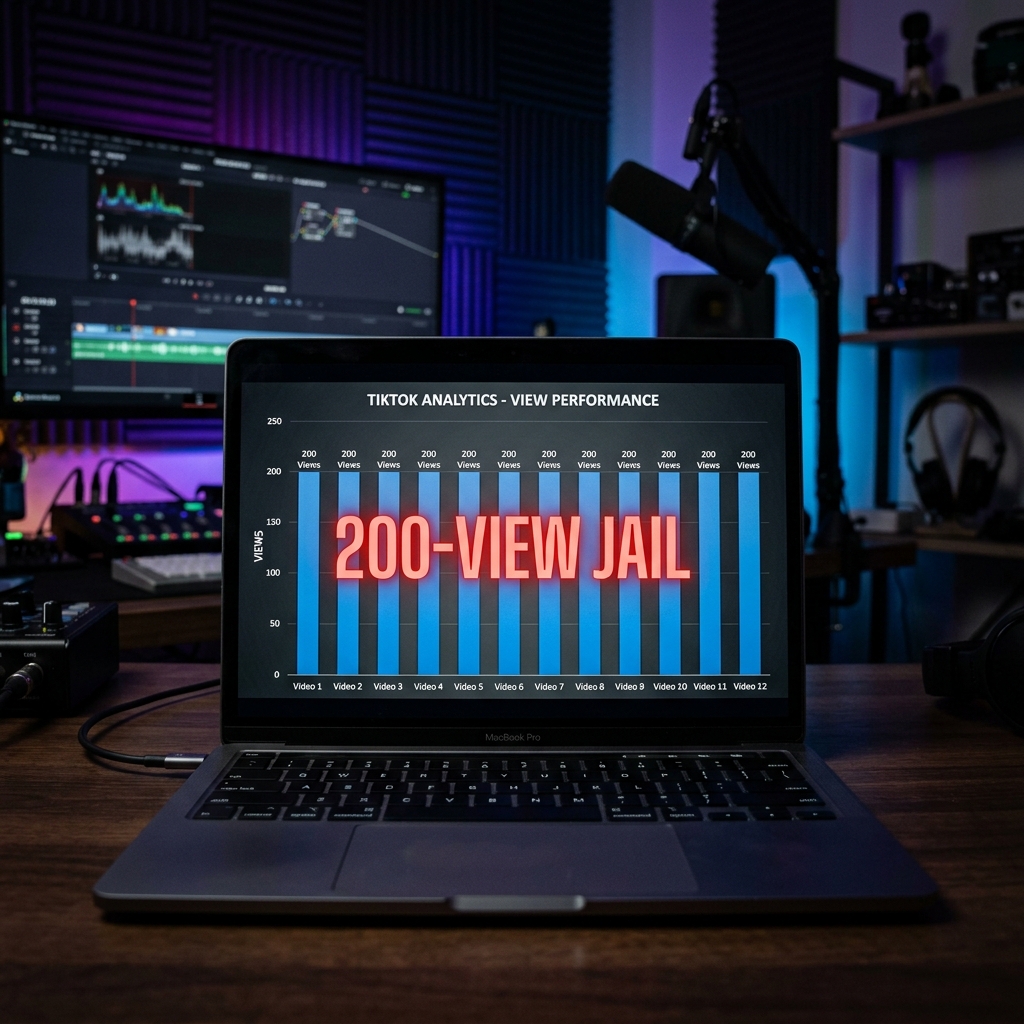
Video 1: 215 views. Video 2: 198 views. Video 3: 204 views.
Same account, different days, and a view cap that stops almost exactly at the 200-view mark.
This is the phenomenon creators call “200-view jail.” It is not a myth. However, it is also not a shadowban, a device penalty, or a platform glitch. It is the metric representation of a video that failed to pass TikTok’s first-tier test group.
Here is the algorithmic truth behind the 200-view limit, and the exact steps to optimize your video structure to break the view ceiling.
How the Test Pool Algorithm Works
When you upload a video, TikTok does not distribute it to millions of users instantly. Instead, it places your video in a gated testing queue:

- The Test Group (Tier 1): The algorithm serves your video to a small test pool of 200 to 300 users on their For You Page.
- The Measurement: The system monitors their response:
- 3-Second Watch Time: The percentage of users who watch past the 3-second mark (Target: 60%+).
- Completion Rate: The percentage of users who watch the entire video (Target: 20%+).
- Engagement Rate: Likes, shares, and comments (Target: 10%+).
- The Decision: If your test group metrics meet the targets, the system releases the video to Tier 2 (1,000–5,000 views). If the metrics fall short, the distribution loop stops, and your video flatlines.
Getting stuck at 200 views is not a punishment; it is proof that your video failed to keep the initial test group engaged past the first 3 seconds.
Why Your Videos Are Flatlining
If every video you post gets capped at 200 views, audit your video structure for these three issues:
1. The Slow Hook
If your video starts with a logo, a generic introduction (e.g., “Hey guys, what’s up?”), or a slow-moving scene, users swipe away instantly. If your 3-second watch time is under 50%, the algorithm will terminate distribution immediately, capping you at the 200-view mark.
2. Lack of Visual Pacing
If a video features a single static camera angle for 15 seconds without cuts, zoom transitions, or text pop-ups, the user’s brain gets bored. The average user has a short attention span; your video must feature a visual transition or cut every 3 seconds to maintain retention.
3. Mismatched Category Signals
If your description is blank or uses generic hashtags (#fyp, #viral), the algorithm does not know who to test your video on. It sends it to a random test group. Because the random audience has no interest in your niche, they swipe away, killing your video’s metrics.
How to Escape 200-View Jail
To break the 200-view barrier, apply this restructuring plan to your next post:
- Use the “3-Second Rules”: State the exact value of the video in the first 3 seconds visually and audibly (e.g., “This is the fastest way to edit video in CapCut.”).
- Write Niche-Specific Descriptions: Use 3 to 4 highly specific keywords in your caption to ensure the algorithm routes your video to a relevant test group.
- Increase Cut Density: Add visual changes (zoom-ins, zooms-out, b-roll overlays) every 2.5 to 3 seconds to reset the viewer’s attention span.
[!TIP] If a video is stuck at 200 views on TikTok, do not assume it is low-quality. The test pool algorithm is highly volatile. Use VDTik to download the clean, watermark-free copy of the video and post it as a YouTube Short or an Instagram Reel. Often, the alternative platform’s test group will respond differently, allowing the video to go viral elsewhere.